
Get Started

[A.CA / REGISTER]

The public surface governed from one authoritative source

REGISTER controls how institutional content is authored, reviewed, revised, approved, and released. It moves the content management system out of the commodity website layer and into the same authority model that governs the rest of the operation.

Author Structured content creation within defined roles, fields, templates, and publishing boundaries.
Approve Review paths, revision states, release authority, and controlled movement toward publication.
Release Approved content issued to the public surface from the authoritative operating environment.
REGISTER / Publishing Authority

The website should not become a separate system of record

Conventional content management systems treat the public website as an isolated publishing destination. Content is drafted in one place, approved through another, supported by files scattered elsewhere, and ultimately released through a platform with little connection to the organization’s deeper authority model. REGISTER restores that path. Content remains governed by the same users, roles, records, and controls responsible for the institution behind it.

Structured authorship

Pages, articles, notices, case studies, briefings, and other content types are built through controlled fields and repeatable structures rather than unrestricted editing.

Approval paths

Draft, review, approval, publication, and archival states can reflect the organization’s actual release authority.

Revision history

Changes can be attributed, compared, recovered, and retained as part of a defensible publishing record.

Role boundaries

Authors, editors, reviewers, administrators, and specialized contributors can operate within defined permissions.

Asset stewardship

Images, documents, downloads, and supporting media remain organized around their purpose, use, and publication state.

Surface continuity

REGISTER can govern an existing public layer or operate as the publishing capability inside a larger OVRSYT deployment.

Controlled Publishing Surface

Content moves through authority before it moves into public view

REGISTER is designed around the point where internal knowledge becomes an external statement. Authors can prepare content without receiving unrestricted control of the site. Reviewers can inspect the record without rebuilding context from messages and documents. Authorized users can approve release with a clear understanding of what changed, who changed it, and where it will appear.

Draft Content begins inside a structured record with ownership, status, and defined publication targets.
Review Editors and reviewers can evaluate copy, assets, metadata, and revisions before release.
Approve Publication authority remains separate from authorship where the operating model requires it.
Publish Approved content is issued to the intended surface without breaking custody of the source record.
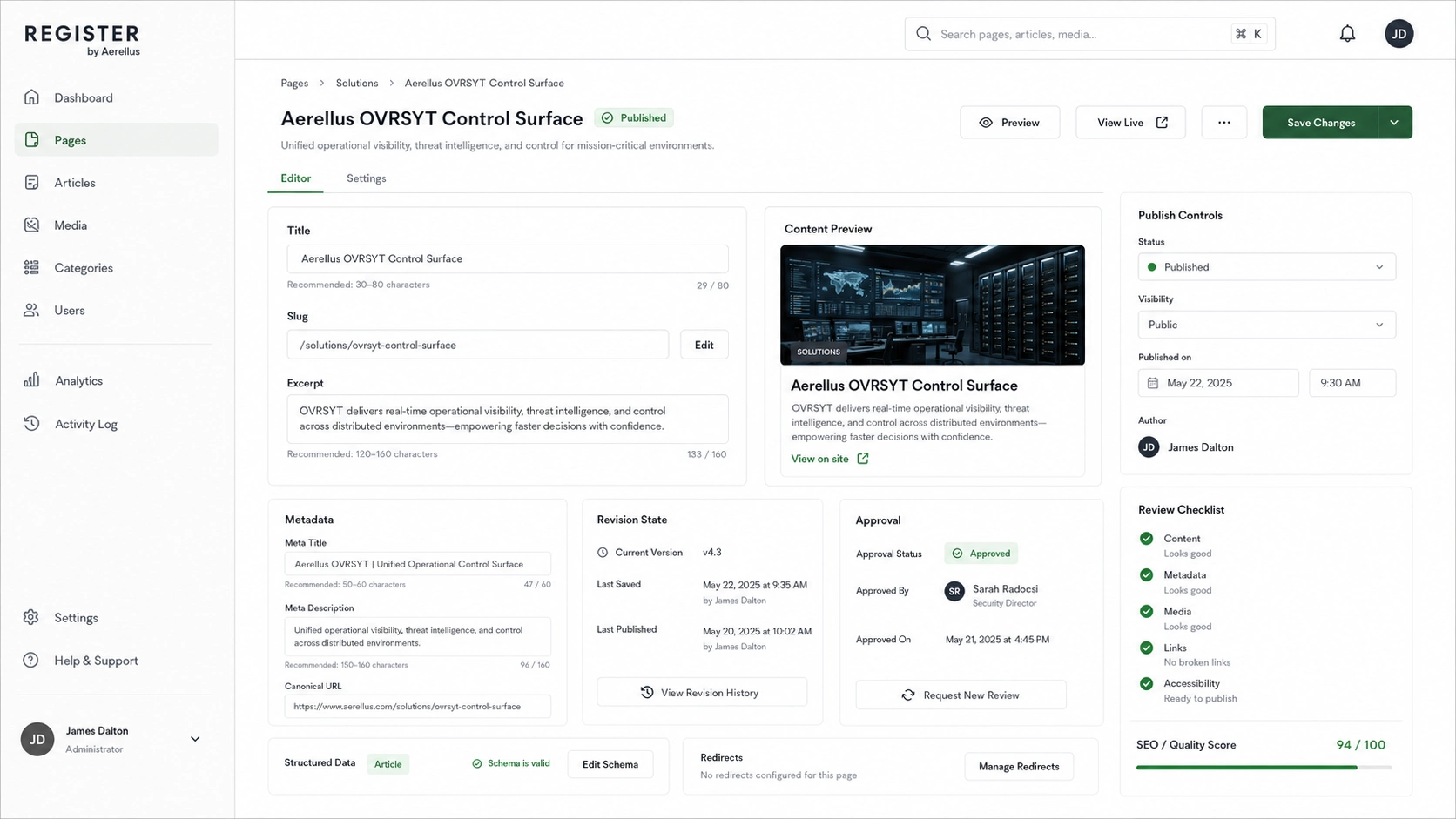
REGISTER controlled publishing interface inside the Aerellus operating surface
Structured content record, review state, revision visibility, and publication controls inside REGISTER.

REGISTER Doctrine

Publication is an authority function

A public-facing statement may carry legal, operational, reputational, or institutional consequence. REGISTER treats publication accordingly: not as a cosmetic website task, but as controlled movement from internal source to external surface.

01

The source remains authoritative

Public content should originate from a governed record rather than from detached edits made directly against the visible website.

02

Authorship and release can remain separate

The ability to prepare content does not have to carry the authority to publish it. REGISTER supports clean separation between contribution, review, approval, and release.

03

Revision becomes part of the record

Content does not simply change. It moves through identifiable versions, decisions, and states that can be understood after publication.

04

The public layer remains connected

REGISTER keeps the website tied to the operating environment beneath it, allowing a focused public deployment to expand into OVRSYT without rebuilding the foundation.

Deployment Model

Mounted inside OVRSYT or deployed as the controlled publishing layer

REGISTER can operate as the content and publishing capability inside OVRSYT or as a focused CMS deployment for an organization that first needs control of its public surface. In either form, the objective remains the same: establish one governed source for content, roles, revisions, approvals, assets, and release.

OVRSYT mounted

REGISTER can operate inside the full workspace, drawing authority and context from the same users, roles, organizations, and records.

Focused CMS deployment

Organizations can deploy REGISTER as a controlled publishing environment without adopting the entire OVRSYT surface at once.

Custom content models

Page types, article structures, case studies, resources, profiles, notices, and specialized records can be shaped around the deployment.

Permissioned publishing

Access can be governed by role, content type, section, action, approval level, and organizational responsibility.

Existing-site integration

REGISTER can govern content for an established public surface where replacement of the entire front end is not immediately required.

Prepared expansion

A focused CMS deployment can later connect into deeper OVRSYT functions without forcing teardown of the publishing foundation.

Return to capabilities >
Aerellus / Insights

Latest Briefings

Recent articles on platforms, controlled systems, operational infrastructure, and the doctrine behind serious digital environments.

The Cost of Fragmented Operations

The Cost of Fragmented Operations

Organizations rarely lose control all at once. Control erodes when work moves across disconnected systems, forcing teams to rebuild context, repeat movement, and defend records that were never structured cleanly in the first place.

Read Briefing →

The System Behind the Work

The System Behind the Work

Most operational drag is not caused by lack of effort. It comes from scattered information, disconnected tools, unclear ownership, and workflows that depend too heavily on memory. Strong infrastructure gives the organization a working surface it can trust.

Read Briefing →
Engage

Bring the publishing problem

Bring the fragmented CMS, unclear approval path, unmanaged revision process, asset sprawl, publishing bottleneck, or public surface that has become disconnected from the organization behind it. REGISTER can be deployed as a focused publishing capability or mounted inside the larger OVRSYT operating surface.

contact@aerellus.com >