
Get Started

[A.CA/ CAPABILITIES]

Capabilities for Controlled Operations

Aerellus capabilities operate inside OVRSYT or independently where one controlled function can remove exposure from the larger operating environment.

Control Document movement, access, communication, scheduling, and work-state logic.
Continuity Capabilities designed to operate inside OVRSYT or stand alone without breaking the model.
Extension Focused tools that can start small, remove exposure, and connect into deeper infrastructure.
Capability Architecture

One operating doctrine across every controlled function

Aerellus capabilities are designed as parts of one operating model. Each function reduces fragmentation, preserves authority, and keeps movement tied to the work. They can operate together inside OVRSYT or be deployed independently where one exposed function needs immediate control.

Shared authority

Access, action, approval, and release are governed through defined roles rather than scattered across disconnected tools and personal accounts.

Shared context

Documents, schedules, messages, meetings, publishing activity, and work-state movement remain connected to the record that gives them meaning.

Controlled movement

Information moves through deliberate paths with clearer custody, fewer exposed handoffs, and stronger visibility into what changed and why.

Focused deployment

A single capability can be deployed first when one operational gap requires immediate correction without forcing adoption of the full platform.

Prepared expansion

Standalone capabilities are structured to connect into OVRSYT later without rebuilding the foundation or replacing the initial deployment.

One environment

When mounted inside OVRSYT, each capability contributes to the same operating surface instead of becoming another isolated application.

[CONTROLLED CAPABILITIES, NOT DISCONNECTED TOOLS]

[DEPLOY THE EDGE, EXTEND THE OPERATING SURFACE]

Capability doctrine

Each component has to reduce fragmentation

A capability only matters when it gives the organization more control. Aerellus components are built to replace exposed handoffs, scattered tools, repeated movement, and operational gaps that usually sit between the public surface, the workspace, the client, and the record.

01

Operate inside OVRSYT

Each capability can function as part of the OVRSYT operating surface, giving matters, documents, messages, schedules, meetings, reports, and client access a shared context.

02

Deploy without the full platform

Not every organization needs the full operating surface on day one. A focused capability can be deployed first when one exposure point needs immediate control.

03

Preserve the record

The work should not disappear into inboxes, shared folders, meeting links, or unmanaged conversations. Capabilities are structured to keep movement tied to the operation.

04

Extend without teardown

A capability can become the first edge of a larger environment. The architecture is built so organizations can extend into OVRSYT without rebuilding the foundation.

Blackline / Immediate Access

Controlled transfer for records that should not remain exposed

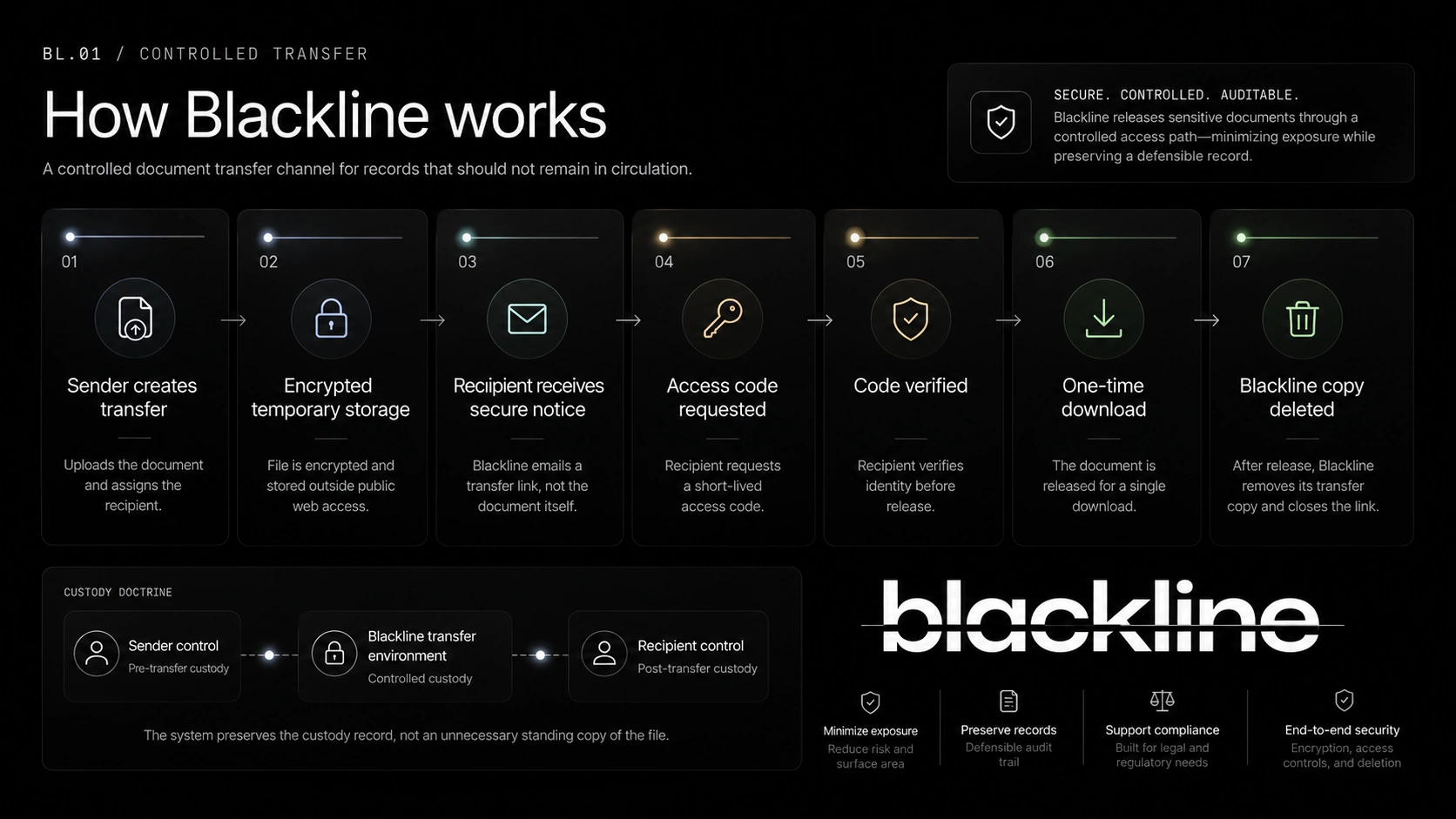
Blackline is the first standalone Aerellus capability because the need is immediate. Sensitive records are still moved through attachments, shared folders, transfer links, and unmanaged copies. Blackline gives the sender a controlled transfer path with access verification, custody trace, one-time release, and removal of the transfer copy after access.

Sender control

The sender creates the transfer, assigns the recipient, and releases the document through a controlled path instead of attaching the file directly.

Recipient verification

The recipient requests access, receives a short-lived code, and verifies before the document is released.

Single release

Blackline is designed around one-time access and controlled consumption, not standing exposure through a reusable link.

Copy removal

After release, Blackline removes its transfer copy and closes the link, preserving the custody record without unnecessary file circulation.

OVRSYT components

Built into the workspace, not bolted onto it

The value of OVRSYT is not that it lists modules. The value is that the modules understand the same operation. A matter can carry its documents, meetings, messages, schedule, reports, participants, permissions, and activity without forcing the team to reconstruct context across separate tools.

Scope

The working record for matters, cases, projects, engagements, reviews, inquiries, and other operational work items.

KADENCE

The rhythm layer: calendar views, deadlines, availability, assignments, mailbox handling, and scheduled activity tied to the operating record.

Explore KADENCE

Threshold

The live office layer: secure meetings, participants, room activity, quick notes, and related records in the same environment.

Relay

The communication layer: messages, replies, internal notes, client updates, and operational threads connected to the work.

Blackline

The transfer layer: controlled release for documents that need to move without leaving unnecessary standing exposure.

A la carte deployment

One capability can become the first controlled edge

Some organizations are not ready to replace the full stack. They may only need controlled transfer, structured intake, secure meeting context, or a cleaner public access path. Aerellus can deploy a single capability first while preserving the architecture required for deeper operational infrastructure later.

Focused entry point

Begin with the exposure point that matters most: transfer, access, scheduling, communication, intake, or record structure.

Operational fit

The capability is shaped around the way the organization works, not forced into a generic SaaS pattern.

Prepared expansion

The first capability can later connect into OVRSYT or a private deployment without forcing the organization to start over.

Same doctrine

Whether standalone or platform-mounted, the capability exists to reduce fragmentation and move the work under control.

Aerellus / Insights

Latest Briefings

Recent articles on platforms, controlled systems, operational infrastructure, and the doctrine behind serious digital environments.

The Cost of Fragmented Operations

The Cost of Fragmented Operations

Organizations rarely lose control all at once. Control erodes when work moves across disconnected systems, forcing teams to rebuild context, repeat movement, and defend records that were never structured cleanly in the first place.

Read Briefing →

The System Behind the Work

The System Behind the Work

Most operational drag is not caused by lack of effort. It comes from scattered information, disconnected tools, unclear ownership, and workflows that depend too heavily on memory. Strong infrastructure gives the organization a working surface it can trust.

Read Briefing →
Engage

Bring the exposure point

Bring the document movement, scheduling problem, communication gap, intake path, matter structure, or operational capability that needs to exist. Aerellus can deploy the focused component or connect it into the larger operating surface.

contact@aerellus.com >