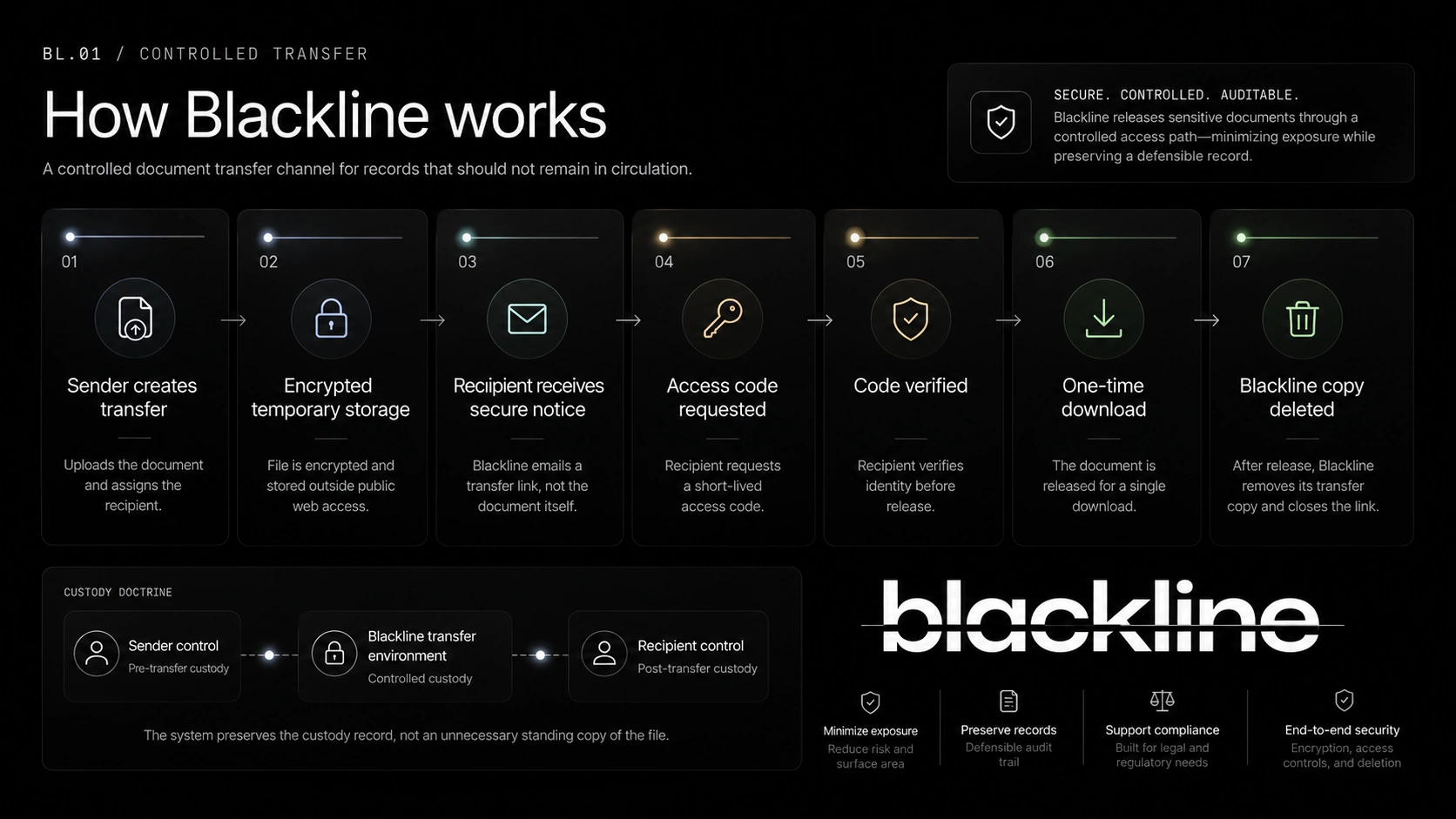
Most organizations do not become fragmented because they lack tools.
They become fragmented because they have too many tools performing isolated parts of the same operation.
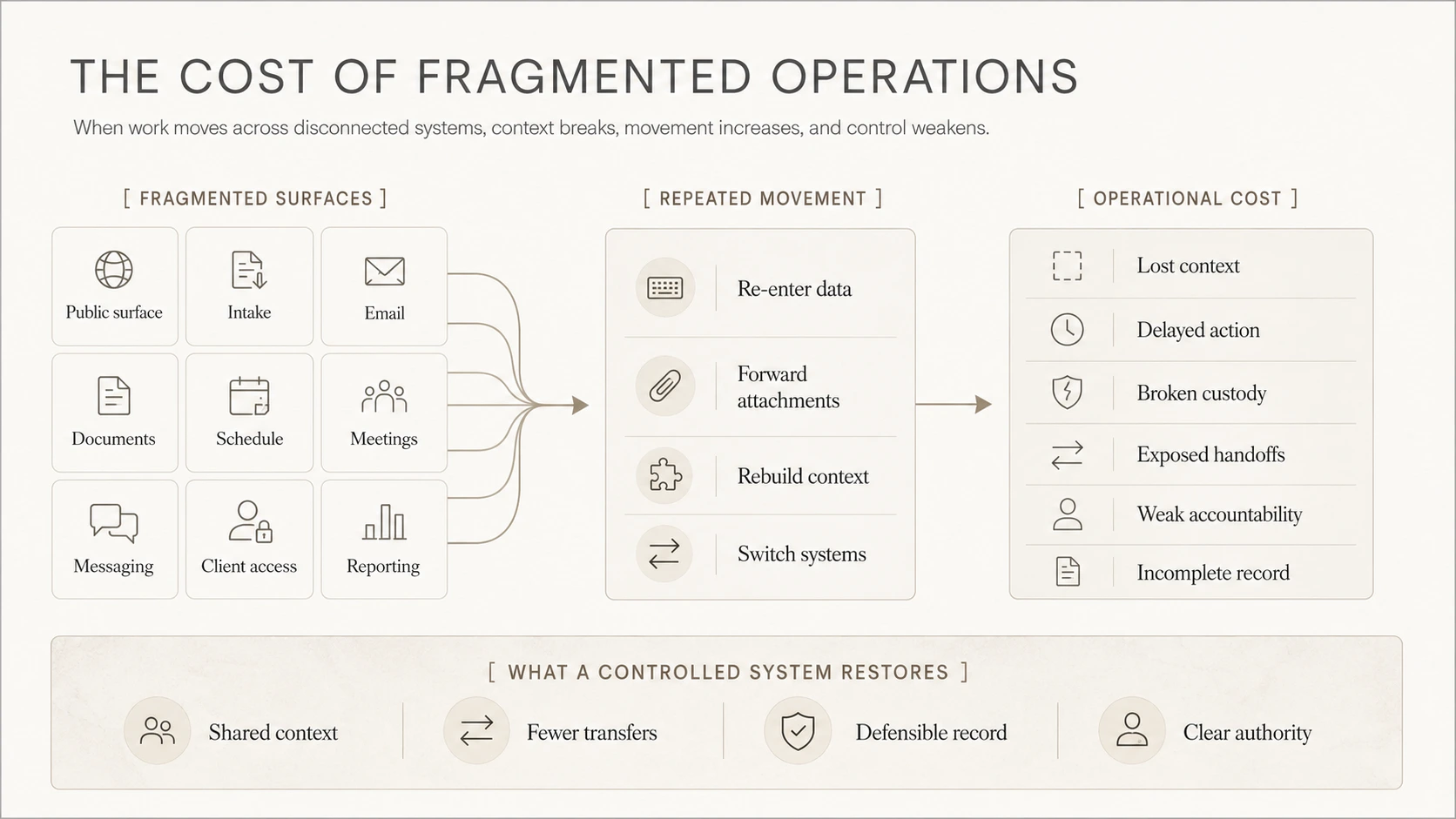
A public form captures the inquiry. An inbox receives the follow-up. A shared drive holds the files. A calendar manages the meeting. A video link hosts the conversation. A message thread carries the internal discussion. A spreadsheet tracks the status. A portal gives the client partial access. A report is assembled somewhere else.
Each piece may appear functional on its own. Together, they create a working environment where the operation is constantly being reconstructed by the people inside it.
That reconstruction is the hidden cost.
The visible cost of fragmentation is usually easy to name: subscriptions, administrative time, duplicate software, and broken workflows. The deeper cost is more operational. Context weakens. Authority becomes less clear. Documents move without a clean custody path. Conversations separate from the record. Teams make decisions based on partial visibility. The organization starts relying on memory, screenshots, message searches, and manual discipline to hold the work together.
That is not a controlled system. It is an arrangement of exposed handoffs.
Fragmentation begins where context breaks
The first failure point is not always a security breach or a missed deadline. It is often smaller.
A file is sent outside the main record. A client replies to the wrong thread. A meeting occurs without the notes being attached to the matter. A deadline is added to one calendar but not tied to the work item. A staff member updates a spreadsheet, but the client portal still shows an older status. A report is drafted from information gathered across multiple locations.
Nothing catastrophic has happened yet. But the organization has already lost a degree of control.
Once context separates from the work, every later action requires interpretation. The team has to determine which version is current, which conversation matters, which document was final, which deadline controls, and which system contains the authoritative view.
That creates operational drag. More importantly, it creates defensibility problems.
A fragmented environment makes it harder to answer basic questions with confidence:
Who had access?
When did the document move?
What was the status at the time?
Which conversation informed the decision?
Was the client working from the correct version?
Where is the complete record?
If those answers require searching across inboxes, drives, calendars, chat tools, meeting platforms, and internal notes, the system is already carrying unnecessary exposure.
Repeated movement becomes invisible labor
Fragmented operations force people to move the same information repeatedly.
A client submits information through one surface. A team member copies it into another. A document arrives by email and is uploaded to a folder. A meeting is scheduled in a calendar, then referenced in a message, then summarized in a note, then attached to a case. A task is discussed in chat and later recreated in a project tool. A report is assembled by pulling pieces from multiple systems that were never designed to share authority.
This movement feels normal because most organizations have adapted around it.
But normal does not mean controlled.
Every repeated movement creates a chance for delay, omission, duplication, misrouting, or version conflict. Every transfer adds a small decision point. Every decision point depends on the person moving the information to understand where it belongs, who should see it, what record it supports, and what level of control it requires.
That is a fragile operating model.
The problem is not the presence of individual tools. The problem is that the tools do not share a governing structure. They do not know the matter, the client, the assignment, the authority, the document state, or the operational context unless someone manually reintroduces that context every time the work moves.
At scale, this becomes a structural tax on the organization.
The record becomes something assembled after the fact
A strong record should form as the work happens.
In fragmented environments, the record is often assembled later.
That difference matters.
When the record is assembled after the fact, it depends on retrieval. The organization has to gather documents, messages, meeting notes, approvals, calendar history, client communication, internal decisions, and supporting materials from separate locations. Even when everything can be found, the chain is weaker because the system did not preserve the relationship between those actions as they occurred.
The record becomes a reconstruction.
Reconstruction is slower, less complete, and less defensible than capture by design.
This is especially important in environments where custody, confidentiality, client communication, deadlines, approvals, or sensitive documentation matter. If the organization cannot clearly show how work moved, who touched it, what changed, and what authority governed each step, then the operational record is incomplete even if the files still exist.
A document sitting in a folder is not the same as a document tied to the work, the user, the access event, the release window, the client, and the resulting action.
A meeting on a calendar is not the same as a meeting connected to the matter, the participants, the notes, the follow-up tasks, and the related documents.
A message in a thread is not the same as communication preserved inside the operational record.
Fragmentation does not always delete information. It separates information from meaning.
Speed can disguise exposure
Many fragmented systems appear fast in the moment.
Email is fast. Shared links are fast. Chat is fast. External meeting tools are fast. Spreadsheets are fast to create. A lightweight portal can be fast to launch.
The issue is not whether these tools can move information quickly. The issue is whether they preserve control while doing it.
Speed without control often pushes exposure downstream. The team may move quickly during intake but lose structure during handoff. It may send documents quickly but weaken custody. It may schedule meetings easily but separate the conversation from the record. It may communicate rapidly but leave decisions trapped in unmanaged threads.
This creates the illusion of efficiency.
The organization feels active, but the work is scattered. People are moving. Systems are updating. Messages are being sent. Meetings are happening. Files are changing hands.
But no single environment owns the operating picture.
That is the real cost of fragmentation: activity increases while clarity decreases.
A controlled system reduces movement
Aerellus approaches this problem from a different premise.
A capability should not exist merely because it performs a function. It should reduce fragmentation. It should remove exposed handoffs. It should keep movement tied to the work. It should strengthen the record as the operation progresses.
That is the doctrine behind OVRSYT and the capabilities built around it.
Documents, scheduling, meetings, messages, matters, reports, client access, and public intake should not behave like separate islands. They should operate with shared context. When a document moves, the system should know what it belongs to. When a meeting is held, it should remain connected to the work. When a message is sent, it should not disappear into an unmanaged channel. When a client accesses information, that access should be governed by the same operational structure as the rest of the environment.
The goal is not to make every organization use one monolithic tool for everything. The goal is to stop forcing critical work through disconnected surfaces that cannot preserve authority, context, or custody.
Sometimes that means deploying a full operating surface through OVRSYT. Sometimes it means deploying a focused capability first: controlled document transfer, scheduling, secure conferencing, messaging, work-item management, or legal discovery support. The measure is the same either way.
Does the capability reduce movement?
Does it preserve the record?
Does it clarify authority?
Does it close an exposure point?
Does it allow the organization to extend without rebuilding the foundation?
If the answer is no, the tool may add convenience, but it does not add control.
The operating picture should not depend on memory
A fragmented organization depends too heavily on people remembering where things happened.
The analyst remembers the file was in the shared drive. The coordinator remembers the client sent an updated version by email. The manager remembers the meeting notes were in a document. The investigator remembers the deadline was mentioned in a thread. The administrator remembers which portal account had access.
That knowledge may work inside a small team for a while. But it does not scale cleanly. It does not survive turnover. It does not defend itself under pressure. It does not provide a stable operating picture when the work becomes urgent, sensitive, or complex.
A controlled system reduces dependence on memory by giving the work a structured environment.
The system should know the matter.
The system should know the participants.
The system should know the documents.
The system should know the schedule.
The system should know the messages.
The system should know the record.
When those elements share context, the organization gains more than efficiency. It gains continuity.
The cost is not just operational. It is strategic.
Fragmentation limits how an organization grows.
Every disconnected process becomes harder to train, harder to audit, harder to secure, harder to improve, and harder to extend. New staff inherit informal workflows. Clients experience inconsistent surfaces. Leadership loses visibility. Technical upgrades become more difficult because the foundation is not unified. Each new tool solves one problem while adding another handoff.
Eventually, the organization reaches a point where improvement requires teardown.
That is the outcome Aerellus is built to avoid.
A cleaner operating system does not just solve today’s workflow problem. It creates a path for extension. The public surface can connect to intake. Intake can connect to the workspace. The workspace can connect to documents, meetings, schedules, reports, messages, and client access. Focused capabilities can deploy first, then become part of a broader environment when the organization is ready.
The architecture matters because the sequence matters.
Organizations should not have to choose between solving an immediate exposure point and preserving the option to build something stronger later.
Control is restored by reducing fragmentation
The cost of fragmented operations is not always obvious at the start.
It appears gradually: more searching, more forwarding, more manual updates, more uncertainty, more duplicate records, more version questions, more exposed handoffs, more time spent rebuilding what the system should have preserved.
The solution is not more software in the abstract. It is better operational structure.
A controlled system gives work a place to live. It gives movement a path. It gives records continuity. It gives teams shared context. It gives clients a cleaner surface. It gives leadership visibility. It gives the organization a foundation that can extend without breaking apart.
Fragmentation spreads when systems are allowed to remain separate by default.
Control returns when the environment is designed to hold the work together.