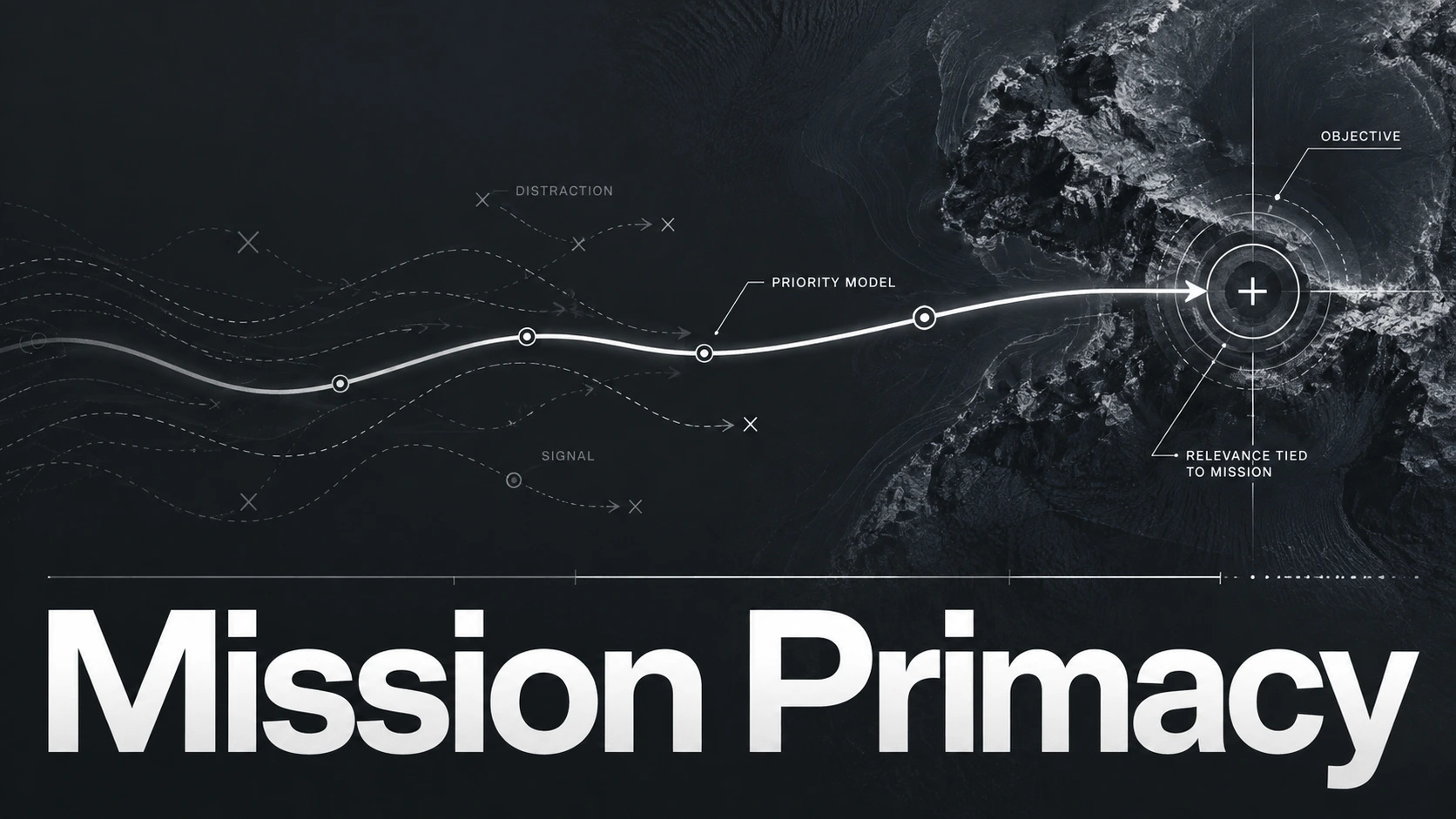
The problem is not simply that operators receive too much information. It is that information systems can turn observations into apparent significance, apparent significance into tasks, and tasks into resource commitments—without ever establishing why the original observation mattered to the assigned mission.
An observation is not a new mission.
Information can consume the very decision capacity it is supposed to improve.
Modern operations generate observations from people, sensors, communications, applications, open reporting, and historical records. Each source can be useful. Together, they can also create a misleading impression that every piece of incoming information deserves immediate attention.
Operational attention is finite. Every newly created lead, unexplained alert, or speculative relationship competes with established requirements. A system that continuously expands the operator’s field of concern can appear highly capable while making the mission harder to execute.
Conventional information management often measures success in records acquired, relationships displayed, events processed, or notifications delivered. Mission Primacy proposes a different test: did the system improve an authorized decision, and did it avoid generating activity that the evidence did not justify?
The expansion problem
A single observation can acquire disproportionate weight through a sequence of small, individually plausible decisions. An analyst makes a tentative inference. A second report inherits the inference as context. A graph renders the inferred relationship without showing its uncertainty. Another user sees the relationship as established and initiates follow-up. The system has created work from an assumption.
This is not necessarily an individual failure. It is an architectural failure when the platform cannot maintain the distinction between observed events, source claims, interpretations, and authorized action.
Information does not carry authority.
Operational environments continuously generate information. Sensors report changes. Intelligence sources introduce claims. Systems correlate events, identify patterns, and surface emerging conditions. Each may contribute to operational awareness. None independently establishes a new objective, priority, or authority to act.
The acquisition of information does not confer operational relevance. Relevance must be established in relation to the authorized mission, its decision requirements, and the conditions under which attention or resources may be redirected.
This distinction is foundational. An information system may identify a technically valid correlation while having no basis to determine that the correlation warrants collection, tasking, or operational expansion.
The information environment must not acquire the authority to redefine the mission.
Information availability is not operational priority.
An event may be accurately reported, independently corroborated, and still have no established relationship to the current objective. Conversely, an uncertain report may warrant immediate attention when it indicates a credible threat to personnel, mission execution, or another explicitly defined critical condition.
Reliability, relevance, urgency, and authority are separate considerations. Systems that collapse them into a single confidence score, alert level, or automatically generated task risk confusing what is known with what should be done.
Reporting enters the operational record with provenance, temporal context, source limitations, and applicable access controls. Retention does not establish mission relevance.
Claims, observations, correlations, and competing explanations are evaluated without converting uncertainty into established fact.
Information receives operational prominence when a defined mission requirement, credible critical condition, or authorized exception justifies it.
Tasking, collection expansion, and resource commitments require an attributable decision under the appropriate authority. A system-generated recommendation does not constitute authorization.
The cost of uncontrolled expansion.
Without explicit promotion controls, information systems can create operational momentum. An observation produces a correlation. The correlation generates an alert. The alert creates a new analytical requirement. Subsequent reporting reinforces the original priority, even when the connection to the governing mission remains unresolved.
Each transition may appear reasonable in isolation. Collectively, they can redirect analyst attention, collection capacity, and operational resources toward activity that has never been justified against the assigned objective.
Uncontrolled expansion
New information → apparent significance → automated priority → additional tasking → expanding resource commitment.
Operational activity grows because information exists, rather than because the mission requires the activity.
Mission-bound processing
New information → attributed record → qualified assessment → mission-relevance determination → justified attention or authorized action.
Information remains available for reassessment. Operational priorities remain subject to mission authority.
Preservation without automatic promotion.
Mission Primacy does not require information outside the current objective to be discarded. A report that lacks immediate relevance may acquire significance as additional evidence emerges, operational conditions change, or the authorized mission is revised.
The architectural obligation is to preserve the information and its context while distinguishing passive retention from active operational demand. Deprioritization must be explainable, reversible under appropriate authority, and subject to defined exception conditions.
The adversarial dimension.
Information environments may also be deliberately manipulated. An adversary need not falsify every report to influence operational attention. Authentic events, selective disclosures, repeated claims, and misleading correlations may be introduced or exploited to encourage unnecessary collection, analysis, or resource diversion.
The existence of this possibility does not justify treating every unexpected development as deception. Adversarial explanations remain hypotheses subject to evidence and mission relevance. The system must neither dismiss an emerging threat simply because it falls outside the expected picture nor promote speculation into a new operational objective.
The system may inform the mission. It must not silently become the authority that directs it.
Relevance is a relationship to the mission.
Mission Primacy begins with a recorded operational objective: what the team is trying to establish, what decisions must be supported, and which developments require immediate attention. These become criteria for presentation and recommended action, not permissions to ignore unexpected evidence.
Four governing rules
- Record accurately. Preserve source-reported events and their limitations without inserting unobserved intent or relationships.
- Separate knowing from interpreting. Keep observations, claims, hypotheses, assessments, and decisions distinguishable in the underlying records and the interface.
- Require justified expansion. A proposed alert, new priority, or follow-up task must reference an explicit mission requirement or documented exception.
- Preserve without promoting. Non-actionable reporting remains retrievable and may be reassessed when new evidence arrives; it does not automatically occupy the operator's attention.
Mission Primacy is not a mandate to ignore information, discourage analyst judgment, or enforce an inflexible checklist. It is a discipline governing when information becomes an operational demand.
Preserve uncertainty without turning every possibility into a task.
Build the discipline into the architecture.
A user-interface filter alone cannot solve the problem. If the underlying database has already promoted a tentative inference into an authoritative relationship, hiding the resulting alert does not restore analytical integrity. The separation must exist in the data model, the promotion rules, and the audit record.
Foundational information objects
MISSIONAuthorized objectiveDefines operational scope, decision requirements, responsible roles, relevance policies, and exception conditions.
OBSERVATIONWhat was recordedCaptures source, time, context, directly reported behavior, provenance, and known limitations.
HYPOTHESISWhat may explain itMaintains candidate interpretations and links supporting and contradictory evidence without treating speculation as fact.
ASSESSMENTWhat is justifiedRecords an evaluated judgment, confidence rationale, unresolved assumptions, and revision history.
RELEVANCEWhy it matters hereExplains the relationship between an information item and a specific mission decision, requirement, or exception.
ACTIONWhat was authorizedRecords tasking or escalation separately from analytical records, including who approved the action and on what basis.
Proposed processing sequence
Ingest → Preserve source → Classify evidence → Evaluate mission relationship → Check exceptions → Recommend prominence → Require authorization for expansion → Retain an auditable disposition.
Relevance, confidence, and urgency must remain separate dimensions. A highly reliable observation may be irrelevant to the current objective. A low-confidence warning may still require visibility if it presents a credible, consequential safety concern. The architecture cannot collapse those decisions into a single opaque score.
Mission Focus as an interface expression
The envisioned information picture offers layered views—from broad context through mission-relevant material to immediate decision requirements. Information outside the active focus is de-emphasized, not deleted. Users can inspect why an item was deprioritized and restore full context when appropriate. Exceptional conditions can override ordinary filtering through explicit, reviewable rules.
Principles become testable only when they constrain system behavior.
MP-001Mission bindingEvery relevance decision shall reference a versioned mission objective, decision requirement, or authorized exception.
MP-002Evidentiary separationThe system shall retain explicit distinctions between observed events, source-reported claims, inferred relationships, and evaluated assessments.
MP-003Expansion controlAutomatic conversion of an observation into a new operational task or target shall be prohibited without a defined rule and authorization path.
MP-004Passive retentionItems not promoted into the active mission view shall remain retrievable under applicable authorization and retention policy.
MP-005ReassessmentThe system shall reconsider relevance when new independent evidence, changed mission requirements, or authorized analyst judgments alter the basis for disposition.
MP-006ExplainabilityPromotion and non-promotion decisions shall expose the supporting requirement, evidence references, policy version, and responsible actor or process.
MP-007Critical exceptionsDefined safety, legal reporting, or other mission-critical exception paths shall remain operable even when ordinary relevance filters would de-emphasize an event.
MP-008Human authorityAuthorized users shall be able to challenge or override system recommendations with a recorded rationale, subject to access and policy constraints.
MP-009Source dependenceRepeated reports with a possible common origin shall not be counted automatically as independent corroboration.
MP-010Revision traceThe system shall maintain how an item's relevance, assessment, and tasking status changed over time without silently overwriting prior analytical states.
These are proposed requirements for research and prototype evaluation. Their presence in this paper does not establish that the corresponding software has been implemented or validated.
Prove that the system saves attention without hiding what matters.
Mission Primacy should be evaluated against a clearly defined control condition rather than judged by how much quieter its interface appears. A useful demonstration needs synthetic but realistic mission objectives, irrelevant observations, ambiguous interactions, genuine changes in mission conditions, and unexpected high-consequence events.
Proposed comparative experiment
Provide identical synthetic information streams and decision objectives to a conventional event-feed interface and a mission-bound presentation model. Introduce high-volume reporting, derivative claims, ambiguous correlations, changing mission requirements, and an unexpected high-consequence event. Evaluate whether each system preserves evidence, distinguishes relevance from reliability, and supports justified decisions without unnecessary operational expansion.
How quickly can a user identify the evidence needed for an authorized decision?
How often does the system produce an unjustified target, task, alert, or inferred relationship?
How often does filtering delay or conceal important unexpected information?
Can reviewers trace every displayed conclusion and promotion decision to its supporting record?
Does the approach reduce workload without reducing comprehension or performance?
Does newly independent evidence correctly alter prominence and conclusions when conditions change?
Failure criteria
The prototype should not be considered successful merely because it generates fewer alerts. It fails if it produces unwarranted certainty, quietly discards evidence, suppresses critical exceptions, misrepresents source independence, or prevents an authorized operator from challenging a system decision.
Results must include performance against the comparison condition, false-suppression cases, known limitations, and conditions under which the model should not be trusted. No quantitative improvement is claimed until those tests have been performed.
From operational doctrine to demonstrable capability.
Mission Primacy is intended to inform the developing information-integrity and mission-awareness capabilities of Command-1. Command-1 is the proposed service integration layer; this research investigates the analytical decisions that should govern what its consumers see and what actions the system recommends.
Proposed development gates
- Formalize the model. Establish mission requirements, observation and hypothesis records, event promotion rules, and audit contracts.
- Implement a controlled information environment. Introduce synthetic reporting streams, unrelated events, uncertain correlations, and changes in mission relevance. Verify that information is preserved without automatically generating unsupported priorities or tasking.
- Add change and exception handling. Introduce independent evidence and urgent but unexpected reports to verify reassessment and appropriate surfacing.
- Test against a baseline. Compare workload, decision time, unjustified task creation, and critical omissions.
- Publish findings. Release only verified results with test methods, failures, and limitations clearly identified.
The analytical doctrine, proposed information objects, preliminary engineering requirements, and validation approach are defined here for review. This publication is not evidence of a completed implementation, production availability, or verified performance.
Mission discipline must not become mission blindness.
Excessive narrowing can create its own failure mode: a system that overfits to known requirements may discount the first indicator that those requirements are wrong. Mission Primacy therefore needs explicit escalation exceptions, transparent de-emphasis decisions, periodic review of retained reporting, and human authority to reassess scope.
The architecture cannot establish whether a real-world event was staged from the observation alone. It also cannot guarantee that humans will avoid bias merely because its data structures distinguish evidence from inference. The goal is to make unsupported promotion more visible and less automatic, while creating a measurable basis for continuous refinement.
This doctrine is applicable beyond defense: emergency coordination, industrial operations, incident response, and other decision environments all benefit from separating what can be recorded from what warrants immediate action.