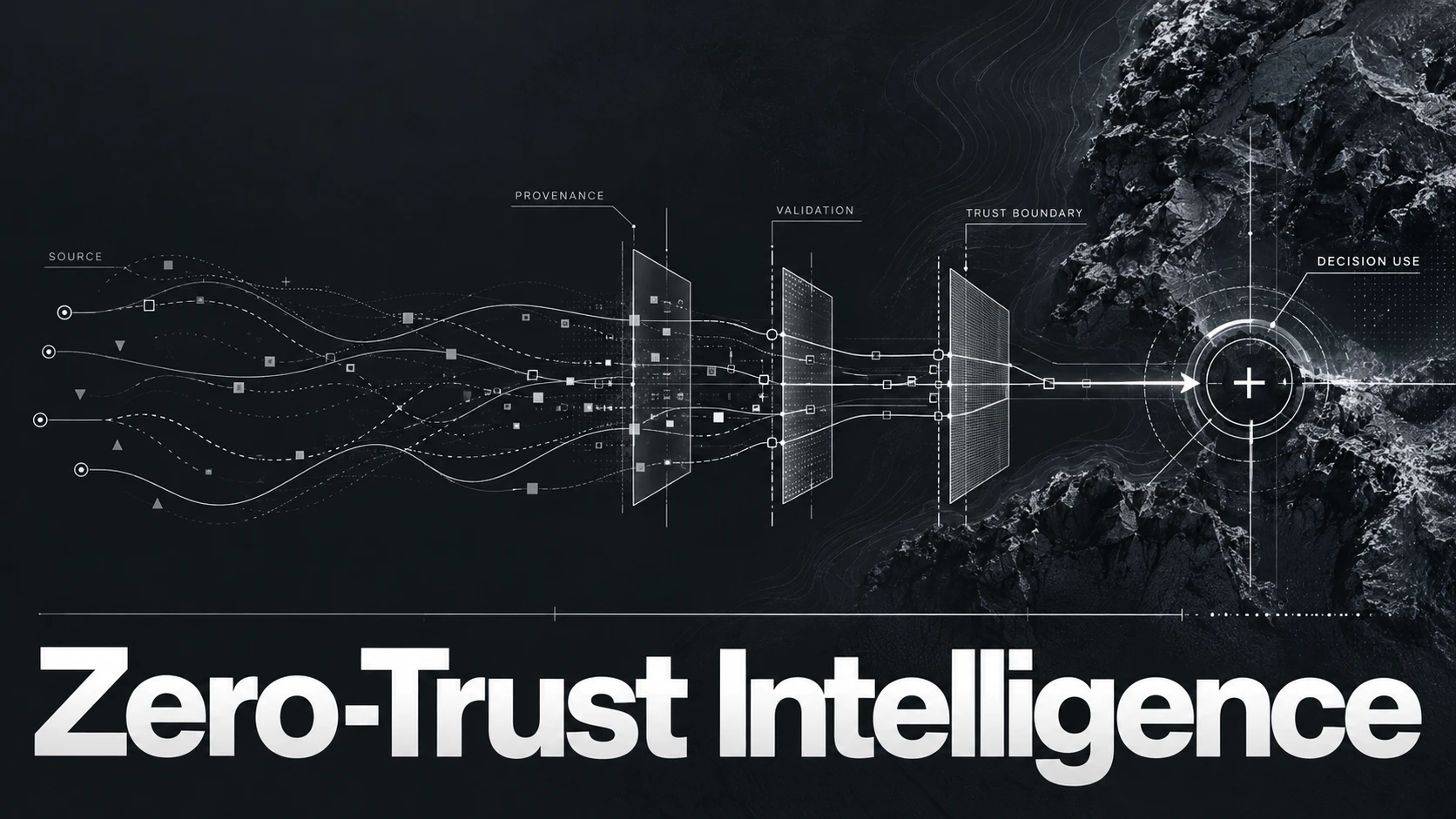
03 / Proposed information trust model
Trust is specific, conditional, and revisable.
Instead of assigning one opaque trust score to every report, a proposed architecture would hold several distinct questions in view. Each question can have its own evidence, access controls, and revision history. High confidence in source identity is not high confidence in interpretation; high confidence that an observation happened is not high confidence that the event was spontaneous.
| Dimension | Question the architecture must preserve |
|---|
| Source identity | Who or what supplied the record, and how strongly is that attribution established? |
| Chain of custody | What transformations, transfers, and revisions occurred after creation? |
| Observation quality | What was directly perceived or measured, under what conditions, and with what limitations? |
| Claim support | Which underlying observations support or contradict the specific assertion? |
| Independence | Do apparent corroborating accounts arise from materially different evidentiary origins? |
| Adversarial exposure | Are there concrete reasons to examine manipulation, staging, selective release, or concealment? |
| Mission relevance | Does the claim warrant the operator's attention or authorized tasking under the current objective? |
Unknown values should remain unknown. The design should permit multiple dimensions to coexist: for example, a strongly authenticated report of an accurately witnessed event may carry unresolved intent and low present mission relevance. That is not a contradictory record; it is an appropriately qualified one.
04 / Adversarial conditions without paranoia
Prepare for deception. Do not presume it.
Information can become misleading through honest error, institutional incentives, translation, selective attention, misunderstanding, deliberate falsehood, or a real event arranged to support a false interpretation. Robust design must permit consideration of these mechanisms. It must also distinguish a documented indicator from an imagined possibility.
Staged truth
A deliberately staged encounter, document release, or observable movement can be factually recorded and still lead an analyst toward the wrong explanation. This illustrates why verification of the observation is necessary but not sufficient. The system should support explicit alternative hypotheses and challenge questions about context, timing, and potential manipulation where those questions are mission-relevant.
Adversarial hypotheses remain hypotheses
Suspicion does not justify indefinite investigative expansion. Similar reporting, a surprising encounter, or unexplained behavior can have ordinary explanations. Analysts should be able to record a deception hypothesis, its supporting observations, its falsification criteria, and its priority—without presenting the hypothesis as the default explanation or automatically generating an investigation.
Challenge must be bounded
An endless search for counterexamples can degrade decision quality as surely as blind acceptance. The appropriate challenge is proportionate to consequence, uncertainty, mission relevance, and the cost of delay. Human authorities must remain able to decide that available evidence is sufficient for a time-sensitive action, with limitations made explicit.
05 / Proposed engineering controls
Build scrutiny into the information lifecycle.
The following requirements propose a research direction for an information-integrity layer in Command-1. They are not representations of current deployed capability.
- Persistent provenance. Records retain attributable origin, timestamps, collection context, transformations, and revision events wherever policy permits.
- Epistemic typing. Observations, claims, hypotheses, assessments, and authorized actions remain distinguishable in storage, APIs, and presentation.
- Claim-specific support. Evidence links attach to a particular assertion rather than inheriting trust wholesale from a report, author, or channel.
- Derivative awareness. The system supports source-lineage review and does not mistake repeated reports for independent corroboration.
- Visible uncertainty. Unknown provenance, disputed identification, incomplete collection, and unresolved interpretations are explicitly representable.
- Alternative hypotheses. Analysts can preserve competing explanations with tests, supporting and disconfirming information, and accountable revision.
- Contextual trust decisions. Trust judgments are scoped to the particular claim and proposed use, not reduced to a single permanent source score.
- Mission-controlled escalation. A suspicious or novel report cannot automatically create a new priority without a documented mission or safety justification.
- Human review and override. Authorized users can accept, challenge, revise, or act despite a warning with an attributable rationale and preserved history.
- Proportionate presentation. Interfaces surface material uncertainty and trust boundaries without burying operators in constant warnings or repetitive confirmations.
06 / Validation against real failure modes
Evaluate acceptance and skepticism together.
A proposed synthetic evaluation would use a set of scenarios that includes high-quality true reports, honest mistakes, copied information, manipulated accounts, accurately reported staged events, disputed observations, and unexpected but significant developments. The underlying scenario truth would be available to evaluators but not necessarily to the simulated operators.
A baseline feed-based workflow and a proposed provenance-aware workflow should be tested with comparable tasks and time constraints. The goal is not to maximize rejection of information. It is to help users make appropriate decisions with fewer unsupported leaps, fewer missed significant events, and a clearer explanation of why they acted.
| Measure | Evaluation question |
|---|
| Unwarranted acceptance | How frequently are unsupported claims used as established evidence? |
| Missed significance | How frequently does caution suppress or delay genuinely mission-critical information? |
| Deception sensitivity | Can reviewers distinguish potentially staged truth from ordinary but unusual events without assuming intent? |
| Provenance recovery | Can a reviewer reconstruct origin, transformations, and supporting evidence? |
| Decision quality | Do users reach better-justified decisions when confronted with conflicting and incomplete reports? |
| Decision latency | Does added scrutiny impose unacceptable delays in time-sensitive conditions? |
| Cognitive burden | Do warnings, scores, and alternative hypotheses distract operators from authorized objectives? |
Failure is not confined to false confidence
Two systems can fail in opposite directions. The first confidently converts weak claims into operational conclusions. The second rejects, downgrades, or delays everything uncertain until critical opportunities are missed. A useful design must make both failures visible and evaluate the tradeoff rather than optimize one metric in isolation.
07 / Governance and boundaries
Scrutiny cannot replace authorization.
Proposed controls must operate within human authority, security restrictions, retention requirements, and source protection. Not every user should see raw source identities. A defensible implementation may show that lineage is shared or restricted while protecting sensitive details from unauthorized access. Transparency should be meaningful and appropriately permissioned.
Protective deception in isolated cybersecurity environments, such as decoys and honeypots, is a separate security research question. It is not an automatic element of this information-trust framework. Actions intended to manipulate other parties' decisions would require separate authorization, review, and governance, and are not implied by this paper.
Nor does the proposed framework license automated accusations against reporters or sources. A potentially misleading report is not necessarily malicious, and a weak claim is not equivalent to an untrustworthy person. The unit of evaluation is the claim in context, with its known lineage and limitations.
Operational authority remains human
Under pressure, decision-makers may need to act on incomplete information. The design must help them know what is supported, what is uncertain, what would change the assessment, and how the contemplated action relates to the mission. It should record accountable judgment without pretending that software can eliminate risk.
Trust should be earned by evidence, not inherited from the system that delivered it.
Publication statusWP-004 is a public, unclassified discussion draft (revision 0.2). “Zero-Trust Intelligence” is an Aerellus research term, not an established external intelligence standard. Scenarios are synthetic. All described controls and evaluations are proposals, not demonstrated, tested, or deployed product capabilities. No classified material, operational case details, or sponsorship claims are presented.