Matter
Connect the record, participants, scope, deadlines, and purpose to the matter that gives them meaning.
[A.IN / LEGAL OPERATIONS]
A legal record must do more than exist. It must withstand questions about origin, authority, access, timing, and change. Aerellus engineers operating environments around that obligation.
[01 / THE CENTRAL PROBLEM]
A document may be authentic and its handling still indefensible.
A record is more than the information inside it. There is also the question of who supplied it, who had access, what version was considered, what authority governed its release, and which decisions depended on it.
When those facts live across inboxes, shared folders, meeting notes, disconnected portals, and individual memory, a team may possess every file and still be unable to reconstruct the sequence that matters.
Defensibility begins before a dispute or inquiry. It is shaped by the way a system permits work to occur, not by the quality of a report assembled after the fact.
[02 / THE CHAIN OF DEFENSIBILITY]
We approach the matter as a governed sequence. Each stage must retain enough context for an authorized reviewer to understand what occurred without inventing what the system failed to record.
Connect the record, participants, scope, deadlines, and purpose to the matter that gives them meaning.
Define who may view, modify, approve, transmit, or release information—and when permission changes.
Distinguish internal, client, counsel, expert, and investigative participation without assuming identity alone grants entitlement.
Associate submissions, reviews, approvals, disclosures, and other movements with actors and relevant versions.
Preserve a reviewable history—including corrections, uncertainty, and documented exceptions—without silently rewriting the past.
If a system cannot explain a consequential change, the organization is left defending a gap instead of an action.
[03 / WHERE CONTROL FAILS]
Most failures do not announce themselves as system failures. They appear later as unresolved questions about a routine movement of information.
An accurate document leaves through an outdated link or an overly broad access group. The issue is no longer the document's contents; it is whether disclosure was authorized and contained.
A team acts on a superseded version while a current document sits elsewhere. Without version lineage and a traceable decision context, reconstructing what was relied upon becomes difficult.
An item moves between counsel, staff, investigators, and external specialists. Missing handoff context creates questions about possession, alteration, and completeness.
[THE ENGINEERING STANDARD]
A system should make the defensible action easier than the undocumented exception.
That does not mean every event can be proven or every risk removed. It means designing the ordinary workflow to preserve accountability rather than asking people to reconstruct it from memory.
[OVRSYT / APPLICATION LAYER]
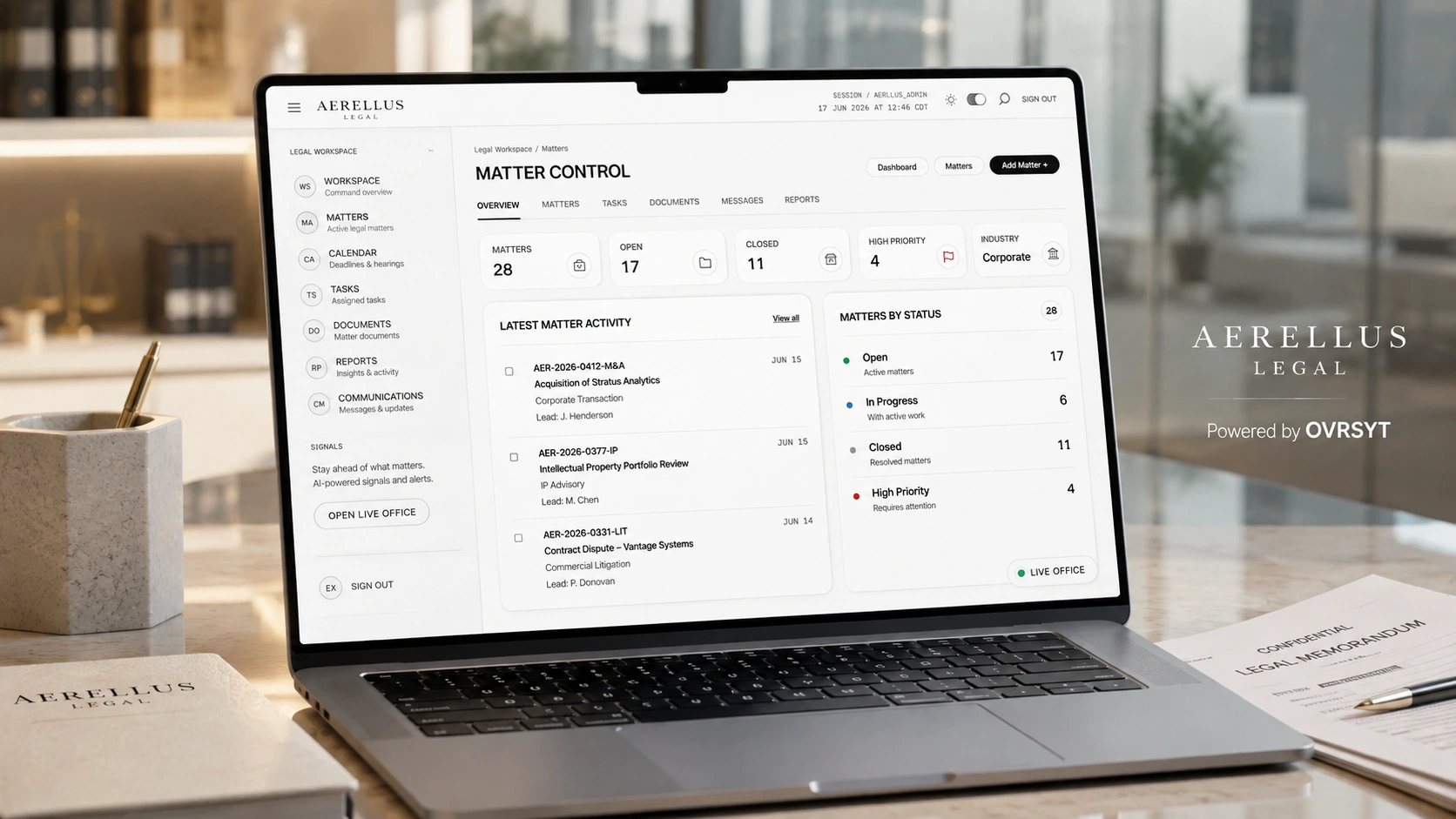
OVRSYT provides an application surface for coordinating work around a matter: documents, participants, communications, schedules, decisions, tasks, and external access. The legal design objective is to connect operational activity to its governing context—not simply consolidate more screens.
[04 / ENGINEERING IMPLICATIONS]
A defensible architecture must account for the authority, record state, and information boundary at the moment of an event. These are design requirements to validate against each deployment's actual legal obligations, practice rules, and threat model.
[05 / LEGAL APPLICATIONS]
Law firms, corporate legal teams, litigation support, regulatory matters, and sensitive investigations all encounter the same fundamental test: can the organization explain what happened, under whose authority, and on what record?
Bring a document release, client access path, evidence handoff, approval sequence, or matter coordination problem. We begin with the exposed process, identify the control boundaries, and engineer from the actual requirements.
contact@aerellus.com ↗