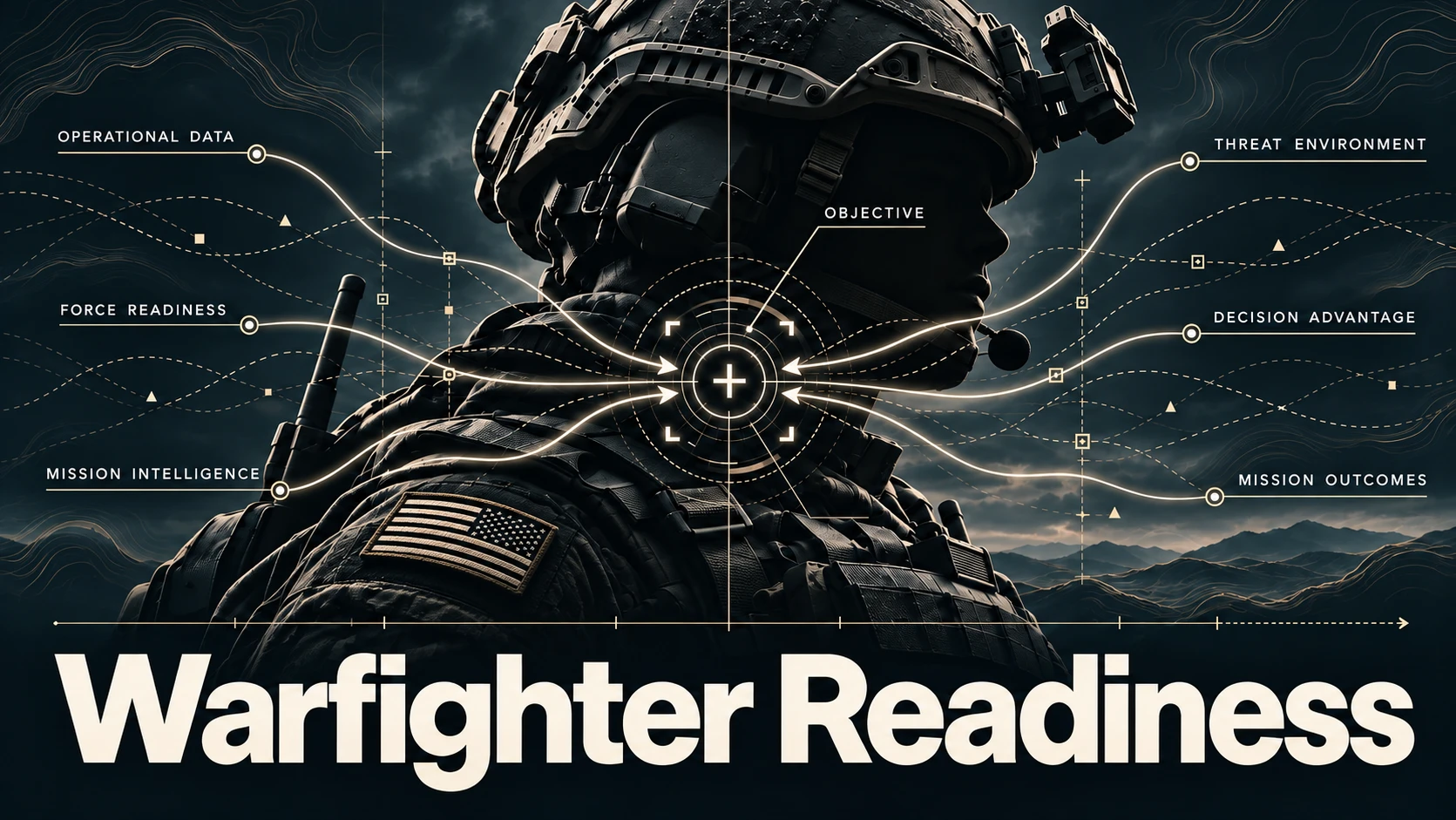
The operational problem is not a shortage of human-performance measurements. It is the possibility that precise measurements will be interpreted as complete measures of a warfighter's ability to contribute to the mission. A system can describe physical condition accurately and still support the wrong operational conclusion.
What is easiest to measure must not become what matters most.
Measurable readiness is not the same as mission capability.
Human-performance programs can observe changes in strength, mobility, recovery, sleep, training load, injury exposure, and other relevant conditions. These measurements can improve prevention, treatment, preparation, and long-term service. They can also introduce a decision hazard when their precision is confused with completeness.
A physical indicator is evidence about a defined physical condition. It is not, by itself, evidence of tactical judgment, team trust, mission familiarity, response under hostile pressure, or the ability to recognize when an apparently ordinary situation has become dangerous. Those characteristics influence operational outcomes but are less readily captured in a continuous sensor stream.
If the most structured inputs receive the greatest weight merely because they are available, a system may favor an operator with stronger measurements while overlooking an operator whose accumulated experience is essential to the element. The result can appear analytically consistent while remaining operationally incomplete.
The substitution error
The substitution occurs when a system is asked, explicitly or implicitly, to answer Who is most capable of accomplishing this mission? but is equipped primarily to answer Who currently presents the strongest measured physical profile? Those are different questions. A valid answer to the second cannot be silently promoted into an answer to the first.
Readiness data remains valuable. The proposed discipline is to preserve the boundary between a measured condition, an assessed limitation, a mission-specific requirement, and an authorized decision.
The issue is validity of use, not the existence of a score.
Military human-performance practice already recognizes multiple domains of readiness. USSOCOM's Preservation of the Force and Family (POTFF) framework addresses physical, cognitive, psychological, social and family, and spiritual dimensions; the Army's Holistic Health and Fitness (H2F) doctrine also takes an integrated approach to human performance [R1, R2]. This paper does not argue that these programs measure only fitness, or that quantitative assessment is inherently unsound.
The narrower engineering concern is decision-use validity. A measurement may reliably describe a defined physical capacity while lacking validated support for a different inference, such as mission suitability, tactical judgment, or the performance of a particular team. Standards for psychological and educational measurement distinguish the quality of a measure from the evidence supporting a particular interpretation and use of its results [R6]. The same discipline should inform readiness software even when the underlying measure is not a psychological test.
The mission determines which capabilities matter.
Mission Primacy begins with the assigned objective. Operational relevance is established by what the mission requires—not by the volume, novelty, or technical sophistication of available information. The same principle applies to human performance. A metric becomes decision-relevant through its relationship to a specific demand, an identified risk, or a supportable intervention.
Physical readiness matters, sometimes decisively. But its significance changes with the task, environment, duration, equipment, support structure, and available personnel. A single universal rating cannot express all of those conditions without losing essential context.
The question is not who has the strongest profile. The question is what gives the mission its highest defensible probability of success.
Individual assessment is not force composition.
A commander may need to determine whether a particular operator can safely meet a specific demand. That is a legitimate individual assessment. A different question asks which combination of people, skills, experience, and support creates the strongest operational element. A system that treats these questions as interchangeable may discard an important option before the full decision is considered.
Metric-centered selection
Measured condition → comparative ranking → implied individual preference → reduced deployment options.
The score becomes a substitute for the operational decision it was meant to inform.
Mission-bound assessment
Assigned objective → required capabilities → individual and team assessment → risk mitigation → authorized composition decision.
The measurements remain useful, but the mission governs their significance.
The second model does not guarantee that more personnel will be deployable. It requires that legitimate restrictions be tied to actual operational, clinical, legal, or safety constraints rather than inferred from an incomplete composite score.
Binding eligibility standards are gates, not weighted preferences. Mission-contextual evaluation begins only after applicable medical, qualification, safety, and other mandatory requirements have been identified. Team complementarity cannot override a required individual capability; the value of experience cannot substitute for a necessary clearance. A system that averages a disqualifying constraint into an otherwise favorable composite has crossed an unacceptable decision boundary.
The stronger individual profile may not answer the mission's question.
Consider two fictional operators being evaluated for a demanding assignment. Operator A presents exceptional physical measurements and strong current recovery indicators. Operator B presents a less favorable physical profile but has extensive, relevant operational exposure, familiarity with the team, and demonstrated judgment in conditions similar to those expected.
Neither operator is inherently better. Nor can age, fitness, or years of service establish how someone will act under fire. A less experienced operator might respond decisively; an experienced operator might make a serious error. Assertions about courage, restraint, adaptability, or stress response require evidence—not stereotypes.
Higher observed physical capacity; fewer measured physical limitations; comparatively limited experience with this mission type.
Some correctable or manageable physical limitations; substantial mission-relevant experience; established knowledge of the environment and team.
Choose A because A's measurable indicators are stronger. This does not establish comparative mission effectiveness.
What role could B perform, what demands must B safely meet, and which team members or support measures could complement B's experience and address the remaining gaps?
The answer may be A, B, both, or neither for a particular role. More importantly, the analysis may reveal that B's experience and A's physical strengths are complementary rather than competing. In some assignments, retaining B within the element may improve A's decision environment and the team's collective performance.
A decision trace, not an automated selection.
The same synthetic case becomes more useful when the system must show the basis for a recommendation. The following gates are proposed for research, not prescribed deployment procedures.
Identify role-specific physical thresholds, qualifications, clinical limitations, and safety requirements. If an operator fails a binding condition, record that limitation; do not offset it with experience or team strengths.
Map each remaining role to tasks, duration, environment, required competencies, and evidence of performance. A general fitness rank alone does not answer these task-level questions.
Inspect role coverage, coordination requirements, overlap, and single-person dependencies. Teamwork research identifies behaviors and coordination mechanisms that are not reducible to independently measured individual attributes [R4].
Where authorized, distinguish a correctable limitation from a binding exclusion and document the evidence, timing, and decision authority associated with a proposed intervention.
Expose which evidence informed the recommendation, which conditions were not assessed, who could see each category of information, and which qualified authority made the final determination.
This sequence does not infer a winning operator from illustrative traits. Its purpose is to prevent the software from presenting a definitive answer when the recorded evidence supports only a bounded set of feasible choices.
Experience has effects beyond the individual.
Operational knowledge can influence the behavior of the team around its holder: earlier recognition of an abnormal condition, faster coordination, better anticipation of friction, clearer communication, and judgment about when action or restraint is warranted. These effects are not guaranteed and should not be invented by a model. They are relevant hypotheses to be evaluated when considering team composition.
Do not ask only whether another operator can replace a capability. Ask what capability the entire element loses when that person is removed.
Experience is consequential, but it is not a substitute score.
Operational experience is accumulated through training, repetition, deployment, adaptation, and exposure to consequential decisions. Its value may include procedural fluency, environmental familiarity, team integration, contextual awareness, and the recognition of patterns that are difficult to describe in advance.
Yet experience itself is heterogeneous. Years of service, number of deployments, course completion, and seniority are imperfect proxies for demonstrated competence. Experience can become outdated. Repetition can reinforce poor habits. Effective assessment requires attention to relevance, recency, demonstrated performance, and contrary evidence.
The live operational environment
Performance during live fire or other high-consequence operations may be affected by uncertainty, threat behavior, sleep loss, physical exertion, environmental conditions, equipment, team coordination, cognitive workload, previous exposure, and the timing of decisions. The variables interact. Their combined effect is not reliably represented by adding independent readiness indicators into a universal score.
Some factors can be observed directly. Others can be assessed only through imperfect exercises, records, supervisor evaluation, or after-action evidence. The design obligation is to make the gaps visible rather than assign fabricated numerical certainty to them.
Experience is relevant evidence when its mechanism is understood.
Research on naturalistic decision-making has documented how experienced fireground commanders recognize familiar situations and identify workable responses under time pressure [R5]. The study concerns emergency command rather than special operations, and it cannot be used to infer that an individual warfighter will perform well in an unfamiliar mission. It does, however, establish a defensible research question: whether evidence of task-relevant pattern recognition and prior performance contributes information that is absent from physiological measurements.
For an engineering model, experience should therefore be represented with specificity, recency, transferability, and counterevidence. "Years served" is background context; a documented competency in a relevant task is potentially decision-useful evidence. Neither replaces a mandatory qualification or a current performance assessment.
Operational experience should be represented as contextual evidence where reliable records exist. This paper does not propose estimating courage, judgment, or mission-success probability from age, tenure, biometric data, or a single synthetic composite score.
Preserve capability before narrowing options.
The Principle of Capability Preservation proposes that human-performance systems should identify correctable limitations and support practical pathways to restore, maintain, or adapt operational effectiveness. Their purpose is not to make every operator available regardless of risk. It is to prevent unnecessary loss of capability while respecting binding clinical, safety, qualification, and command constraints.
Five governing rules
- Bind assessment to the mission. Identify actual operational demands before interpreting a measurement as a deployment concern.
- Separate condition from capability. Distinguish observed physical indicators, professional assessments, demonstrated competencies, and mission suitability.
- Assess the element, not only the individual. Consider complementary skills, experience, team cohesion, role distribution, and feasible support without ignoring individual minimum requirements.
- Prefer corrective pathways where legitimate. Present training, recovery, medical care, load management, preparation, or role adaptations when they are supported and appropriate.
- Protect human authority and safety boundaries. Preserve the responsibilities of qualified clinicians and commanders, including the authority to restrict participation when warranted.
These rules do not require a system to recommend deployment. They require it to support a disciplined assessment of both limitations and available remedies, with clear distinction between information, professional judgment, and authorized action.
Make the relevant distinctions visible in the data model.
A dashboard that shows additional experience fields does not by itself solve the problem. The separation must exist in the underlying records, decision logic, provenance, access controls, and audit trail. An individual health measure should never silently become an operational disqualification or a definitive personnel ranking.
Foundational decision objects
MISSIONAssigned requirementRecords the authorized objective, relevant tasks, environmental conditions, role demands, and decision authority.
MEASUREMENTObserved conditionPreserves measurement method, time, source, reliability, baseline, and known limitations.
EXPERIENCERelevant operational historyCaptures authorized, verifiable qualifications and demonstrated experience, including relevance and recency; avoids inferring personal attributes from tenure.
ASSESSMENTQualified interpretationDistinguishes provider findings, operational evaluations, uncertainty, and unresolved limitations.
ELEMENTTeam compositionRepresents roles, complementary capabilities, mission dependencies, and legitimate individual constraints.
INTERVENTIONCapability supportDocuments authorized recovery, treatment, conditioning, preparation, workload, or role-adjustment options and their expected tradeoffs.
DECISIONAuthorized dispositionRecords the responsible authority, governing policy, supporting factors, acknowledged uncertainty, and reason for the outcome.
Proposed processing sequence
Define mission demands → Preserve measurements and context → Identify constraints → Evaluate relevant experience and team dependencies → Explore feasible interventions and compositions → Present uncertainty and tradeoffs → Record authorized decision.
Clinical and non-clinical information must remain separated according to applicable privacy rules. Commanders should receive the decision-relevant operational information they are authorized to see, not unrestricted clinical records. A model intended for health intervention must not be quietly repurposed for personnel selection without explicit governance, validation, and lawful authority.
A decision-use contract for every output.
The same stored measurement may support longitudinal clinical review, training modification, or an operational suitability discussion. Those are different purposes with different permissions, validation requirements, and responsible authorities. The proposed system must describe which inference is supported before presenting a recommendation.
CONSTRUCTWhat was actually measuredThe identified variable, method, collection conditions, comparison population or individual baseline, and relevant measurement uncertainty.
INTENDED_USEWhat can be inferredPermitted interpretation, validated population and setting, time validity, intended decision, and known use restrictions.
CONSTRAINTWhat cannot be traded offApplicable mandatory eligibility, clinical, legal, safety, and qualification conditions that cannot be compensated for by a favorable aggregate score.
RELEASEWho is authorized to knowPurpose-specific disclosure decision, eligible recipient, minimum necessary output, and auditable disclosure basis under applicable policy.
As one concrete example of a domain-specific boundary, DoD Instruction 6490.08 governs particular mental-health command-notification circumstances [R7]. It is not a universal rule for all medical information. A general readiness architecture must implement the applicable disclosure rules for each information type and deployment context rather than substituting a single global "commander view" permission.
The principle must constrain software behavior.
CP-001Mission bindingAny mission-suitability recommendation shall identify the relevant versioned mission demands and authorized decision context.
CP-002Measurement separationRaw measures, trend analysis, clinical interpretations, competence evidence, and deployment decisions shall remain distinguishable.
CP-003Longitudinal contextChanges shall be represented against appropriate individual baselines and measurement conditions, not solely population rank.
CP-004Experience provenanceExperience indicators shall identify source, relevance, recency, and limitations; age and tenure alone shall not establish competence.
CP-005Team-level evaluationAuthorized planning views shall permit examination of role complementarity and dependencies without overriding individual minimum requirements.
CP-006Intervention pathwaysWhere appropriate, the system shall surface actionable support options before presenting a correctable limitation as an irreversible loss of capability.
CP-007Boundary disclosureEvery predictive output shall state the target being predicted, intended use, validation limits, uncertainty, and prohibited inferences.
CP-008Authority separationNo measured indicator or composite score shall independently issue medical clearance, deployment orders, or personnel restrictions.
CP-009Privacy partitionProtected clinical details shall remain subject to appropriate access, purpose, consent, and disclosure controls.
CP-010Audit and challengeAuthorized users shall be able to review why an assessment was presented, correct source errors, record disagreement, and retain decision history.
CP-011Use-bound validityEvery recommendation derived from a measurement shall identify its intended decision use, supporting validation context, source limitations, and circumstances under which the inference is not justified.
CP-012Constraint precedenceHard medical, safety, qualification, or authorization constraints shall remain separately enforceable; weighted scoring or team-level optimization shall not silently override them.
CP-013Temporal validityEvidence shall retain observation and review dates, with explicit handling for out-of-date assessments and a prohibition against treating expired information as current.
CP-014Purpose-bound disclosureInformation exposed to a recipient shall be limited to authorized, decision-relevant content; source clinical data shall not be made broadly visible by virtue of participating in a readiness calculation.
These are proposed design requirements for research and prototype assessment. They are not claims that an Aerellus product currently implements or has validated these functions.
Prove that additional context improves decisions—not merely their appearance.
A proposed model should be evaluated against a documented comparison condition using synthetic, mission-grounded scenarios reviewed by qualified operational and human-performance subject-matter experts. Cases should include strong physical performance with limited task-specific experience, substantial experience with remediable physical limitations, genuine disqualifying constraints, and environments where the younger or less experienced operator is demonstrably the better choice.
Reviewers should be able to assess whether the model supports appropriate individual restrictions, identifies possible interventions, surfaces team dependencies, and preserves the distinction between recorded evidence and inferred capability. Comparison criteria should be defined before tests begin to avoid selecting favorable outcomes retrospectively.
Pre-register the decision task and acceptable error.
A credible experiment should use the same synthetic case library across conditions: a metric-only interface, a multi-domain context interface, and a mission-bound model implementing the proposed separation of constraints, experience, team dependencies, and decision-use limitations. Scenario order should be counterbalanced where possible to reduce learning effects. Reviewers should include qualified operational subject-matter experts and appropriately qualified health professionals, with their distinct judgments recorded rather than collapsed into an assumed single ground truth.
Before testing, define each decision's valid alternatives and prohibited outcomes. Not every case has one correct assignment; some have several defensible compositions. Safety-critical omissions, unauthorized clinical disclosure, and unsupported clearance or exclusion recommendations should be tracked separately from convenience or response-time measures. An improvement in perceived usability must not offset an increase in unsafe recommendations.
The GAO's 2023 evaluation of the Preservation of the Force and Family program identified gaps in the specification of performance goals, measures, collection methods, and evaluation procedures [R3]. That finding concerns program evaluation, not the correctness of any individual warfighter assessment. It reinforces the methodological obligation to define what is being measured, why it matters, and how an outcome claim would be established before calling a data system effective.
Can each capability recommendation be traced to an authorized operational demand?
How often does the model unnecessarily remove a feasible personnel or team option?
How often does the model overlook a legitimate minimum requirement or safety restriction?
Do users identify material experience and team dependencies otherwise absent from a metric-only view?
Are proposed support actions feasible, evidence-based, and appropriately assigned to qualified decision makers?
Can reviewers distinguish source data, professional assessment, model output, and final authority?
Failure criteria
The prototype fails if it fabricates psychological traits, predicts courage from demographics, treats service tenure as proven competence, exposes protected health information improperly, hides safety constraints, or creates false confidence through an unvalidated mission-success score. It also fails if the added context creates unnecessary complexity without improving the defensibility of decisions.
Demonstrations may test process quality and decision support. They cannot establish real-world mission-success gains without an appropriate research design, validated outcome measures, and sufficient evidence. No such gain is claimed in this paper.
From principle to evaluated decision support.
This research is applicable to human-performance systems, readiness tools, training platforms, and other systems that may inform operational personnel decisions. It is not a description of, amendment to, or exception from any government program requirement. The proposal is a complementary engineering discipline for how measurements are interpreted when decisions carry operational consequence.
Proposed development gates
- Define the decision boundary. Document permitted and prohibited uses of physical, experiential, clinical, and operational data.
- Formalize mission-linked evidence. Specify the records, provenance, access controls, and versioned mission demands required to produce a supportable assessment.
- Build synthetic team scenarios. Introduce complementary capabilities, missing experience, recoverable limitations, true safety restrictions, and changing mission conditions.
- Compare decision approaches. Evaluate a metric-first baseline against mission-contextual decision support using predeclared criteria.
- Publish bounded findings. Report demonstrated benefits, incorrect recommendations, unresolved limitations, and conditions where the approach should not be used.
WP-005 states an analytical doctrine, proposed engineering requirements, and a validation plan. It does not establish a deployed capability, completed study, validated predictive model, or measured operational benefit.
Capability preservation is not permission to ignore risk.
An emphasis on experience can produce the same error as an emphasis on fitness if it becomes a preferred answer rather than a factor to evaluate. Experienced operators may have limitations that cannot safely be mitigated for a particular assignment. Less experienced operators may possess essential skills, stronger task-specific competencies, or better demonstrated judgment. Legitimate minimum standards remain controlling where applicable.
Neither commanders nor software systems can know with certainty how an individual will react in an unprecedented event. Experience, training, assessments, and historical performance can support judgments; they cannot eliminate uncertainty. Likewise, support personnel or complementary team capabilities cannot always compensate for an individual inability to perform a required task.
Clinical determinations belong to appropriately qualified and authorized professionals. Deployment and mission-composition decisions remain with the appropriate command authorities under governing policies. The system's responsibility is to present relevant, lawful, appropriately protected information and the limits of its interpretation.
The mission comes first. The measure informs the decision. The people remain the capability.
The purpose of better measurement is better preparation: to protect health, preserve accumulated operational knowledge, strengthen teams, and expand legitimate options for mission execution. The strongest human-performance system is not the one that produces the most favorable readiness dashboard. It is the one that helps decision makers place a capable force into the mission in the best condition reasonably achievable.
Established knowledge informs the question. It does not answer the system-design problem.
The multidimensional nature of readiness is not a new proposition. Military human-performance programs, psychological measurement standards, and decades of team and decision research already recognize the limits of reducing complex performance to a single observed variable. This paper therefore does not claim to have discovered those limitations. It asks how an information system should preserve the distinctions when observations become recommendations with operational consequences.
Relevant doctrine, evaluation, and empirical research
- [R1] / OFFICIAL PROGRAM FRAMEWORKU.S. Special Operations Command. Preservation of the Force and Family (POTFF): About POTFF.
Describes a performance- and readiness-focused, evidence-based, multi-domain program, including physical, psychological, cognitive, social and family, and spiritual domains. The source establishes existing program intent; it does not validate a proposed Aerellus assessment method.
USSOCOM / Official program overview ↗ - [R2] / MILITARY DOCTRINEDepartment of the Army. FM 7-22, Holistic Health and Fitness; doctrine resources listed by the Army, 03 September 2026.
Establishes a broader, integrated human-performance framework and the role of specialized support in preparing personnel. It supports consideration of multiple readiness domains; it does not imply that established standards are optional.
U.S. Army / H2F doctrine update ↗ - [R3] / INDEPENDENT GOVERNMENT REVIEWU.S. Government Accountability Office (2023). Special Operations Forces: Actions Needed to Assess Performance of the Preservation of the Force and Family Program. GAO-23-105644.
Identifies incomplete specification of program performance goals, measures, and evaluation methods as of the 2023 review. Its finding concerns program-level evaluation; it does not show that any particular physical measure is invalid or that a mission-contextual model will improve outcomes.
GAO / Published report ↗ - [R4] / PEER-REVIEWED TEAM SCIENCESalas, E., Sims, D. E., & Burke, C. S. (2005). Is There a “Big Five” in Teamwork? Small Group Research, 36(5), 555–599.
Synthesizes teamwork processes, including leadership, mutual monitoring, backup behavior, adaptability, and team orientation, together with coordination mechanisms. Relevant to why element effectiveness cannot be inferred from independently ranked individuals; not direct validation of a force-composition algorithm.
DOI / 10.1177/1046496405277134 ↗ - [R5] / NATURALISTIC DECISION RESEARCHKlein, G. A., Calderwood, R., & Clinton-Cirocco, A. (1986). Rapid Decision Making on the Fire Ground. Proceedings of the Human Factors Society Annual Meeting, 30(6), 576–580.
Reports evidence of recognition-based decision processes among experienced fireground commanders under time pressure. Provides a research basis for studying task-relevant experiential knowledge while remaining an indirect analogy, not empirical evidence about individual special operations personnel.
DOI / 10.1177/154193128603000616 ↗ - [R6] / MEASUREMENT STANDARDSAmerican Educational Research Association, American Psychological Association, and National Council on Measurement in Education (2014). Standards for Educational and Psychological Testing.
Provides the foundational distinction between measurement, validity evidence, interpretation, and appropriate use. Applied here as a methodological analogy: a score intended for one construct cannot automatically be treated as a validated prediction of unrelated mission performance.
NCME / Testing standards ↗ - [R7] / POLICY BOUNDARYDepartment of Defense (2023). DoD Instruction 6490.08, Command Notification Requirements to Dispel Stigmas in Providing Mental Health Care to Service Members.
Offers a concrete example of disclosure rules that vary by information type, circumstances, and recipient. It governs specific mental-health notifications and must not be generalized to all clinical data or all command-access decisions.
DoD / Official instruction PDF ↗
The Aerellus research boundary
Prior work establishes multi-domain human-performance practice, the limits of unsupported score interpretation, meaningful team processes, and the importance of evaluating actual outcomes. It does not establish whether software can reliably represent mission demands, time-bound measurement validity, mandatory constraints, relevant experience, team dependencies, purpose-specific access, and the authorized decision in one auditable model.
The proposed contribution is a decision-support architecture, not a new clinical instrument or an autonomous personnel-selection authority. Research should determine whether that architecture improves the defensibility and completeness of human decisions against defined baselines, without increasing unsafe inclusion, unjustified exclusion, data disclosure, or misplaced confidence.
Source-use note: Official program descriptions document intended scope, government audits document findings within their review period, and civilian human-factors studies inform hypotheses rather than predict military outcomes. None of these references is evidence of government sponsorship, product validation, or measured mission-performance improvement.